DMV Frontpage Original · Sports
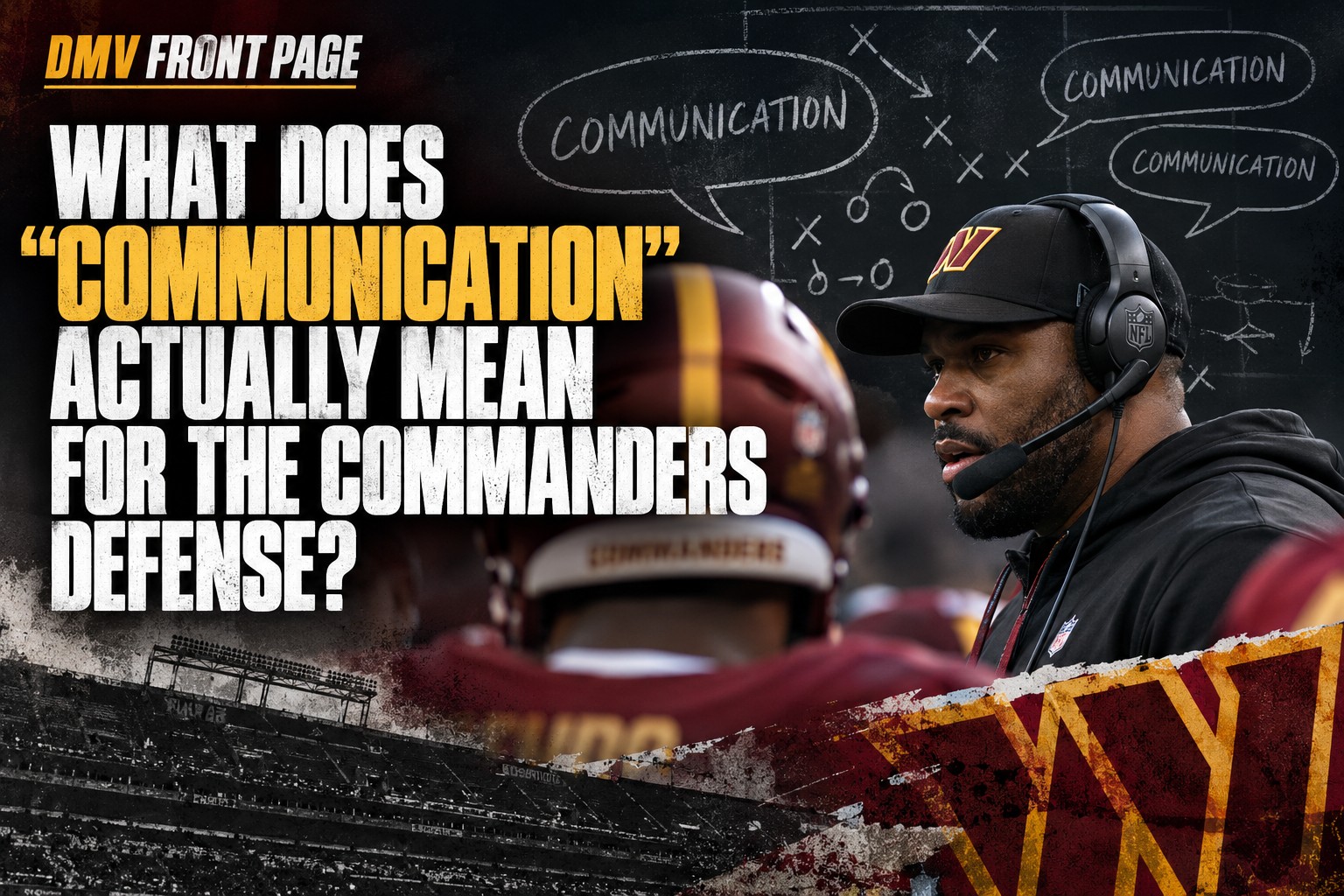
What does “communication” actually mean for the Commanders defense?
Washington has pointed to communication problems on defense for three straight seasons. But the explanation only goes so far without understanding what is actually breaking down.
The Washington Commanders defense had a rough afternoon against the Dallas Cowboys last Sunday, giving up 37 points in a loss that dropped the team to 0-2.
Cowboys quarterback Dak Prescott completed 26 of 31 passes for 279 yards and four touchdowns, while CeeDee Lamb caught eight passes for 153 yards and two touchdowns. It continued a difficult start for a Commanders secondary that had already given up six plays of at least 17 yards against Philadelphia in Week 1, five of them on third down.
When defensive coordinator Daronte Jones met with reporters Thursday, he had an explanation for at least some of what has gone wrong.
Communication.
According to Martenzie Johnson, Jones used some form of the word “communication” 25 times during a press conference that lasted about 15 minutes. Jones talked about figuring out why communication was breaking down and whether the coaching staff needed to take some things off the players' plates so they could line up and play faster.
And there is a perfectly reasonable argument that communication really is part of the problem. Jones didn't start talking about it after the defense struggled against Philadelphia and Dallas. During training camp in August, while installing a defense that uses different fronts, disguises and checks, Jones called “elite communication” one of the standards for his defense. He talked about players recognizing what they were seeing, getting into and out of calls and making sure everyone was on the same page.
But communication has also become a familiar explanation for defensive problems in Washington.
After a 37-20 loss to Tampa Bay in the 2024 season opener, then-defensive coordinator Joe Whitt Jr. talked about communication errors and the need to make sure calls were received and acknowledged. A few weeks later, Whitt said he had streamlined the defensive call sheet after wondering if he had been asking the players to do too much. The idea was to simplify things so the defense could “set their feet and go play fast.”
The explanation returned in 2025. With Washington struggling to prevent explosive plays, Whitt pointed to execution and communication as problems. By November, the Commanders were trying something more significant, moving Whitt from the booth to the sideline in an effort to improve communication and make adjustments faster. That didn't solve the problem either. After Washington allowed 44 points to Detroit, Dan Quinn took over the defensive play calling himself.
Now there's a new defensive coordinator, a different system and several different players, but Washington is again talking about communication.
Mitchell Tischler raised an interesting point about that Thursday during an appearance on 106.7 The Fan. Tischler called communication a “convenient out” because it doesn't directly blame a player or condemn the scheme and is vague enough that it can describe a number of different problems. He believes the larger issue is the talent in Washington's secondary.
Communication shouldn't be dismissed as an excuse, especially considering Jones was emphasizing it before the season began. But after hearing essentially the same explanation across three seasons, it seems fair to ask what the Commanders actually mean when they use the word.
A communication problem could mean a player didn't receive a call or the call was relayed but somebody misunderstood their responsibility. It could mean two defensive backs saw the same formation differently and made conflicting checks. And there could also be plays where everyone understood exactly what they were supposed to do and simply didn't execute it. All of these things aren't necessarily the same problem and they don't have the same solution.
If players aren't getting the call, Washington has to figure out why. If they're having trouble understanding the defense, Jones might need to simplify it. If the scheme is putting players into difficult situations, the coaches have to adjust. And if everyone knows the assignment but a receiver still gets open, then communication probably isn't the problem.
That's where the word can become misleading. Calling something a communication problem naturally suggests that the players on the field are capable of doing what is being asked and simply need to get on the same page. More meetings and reps to get familiar with the scheme and what Jones wants could help. Simplifying calls could also be a solution.
A personnel problem is different because the solution might not already be in the building.
That's what makes the next few weeks interesting for Jones and the Commanders defense. There are legitimate reasons why communication would be especially important in a new and complicated system, and two games isn't enough time to determine whether these problems can be fixed as players become more comfortable in it. But Washington has also spent parts of three seasons talking about communication while changing coordinators, changing calls and changing players.
Communication may accurately describe part of Washington's defensive problem. But at some point, the more useful question becomes what specifically isn't being communicated, why it keeps happening and whether communication is really the problem they're trying to solve.