DMV Frontpage Original · Sports
The Commanders' Penalty Problem Goes Beyond the Number of Flags
Washington's penalty totals are right around the NFL average, but a troubling trend and costly pre-snap mistakes are becoming a bigger problem for the Commanders.
# The Commanders' Penalty Problem Goes Beyond the Number of Flags
The Washington Commanders have spent much of the early season talking about discipline and eliminating self-inflicted mistakes. Those concerns have only grown after two straight games with nine or more penalties, including Sunday's loss to Indianapolis, when an illegal shift erased what appeared to be an 87-yard touchdown.
Dan Quinn has emphasized the need to clean up pre-snap penalties, but Washington's overall numbers suggest the problem isn't necessarily how often the Commanders are being flagged. It's that the penalties are becoming more frequent, and some of the mistakes are proving particularly costly.
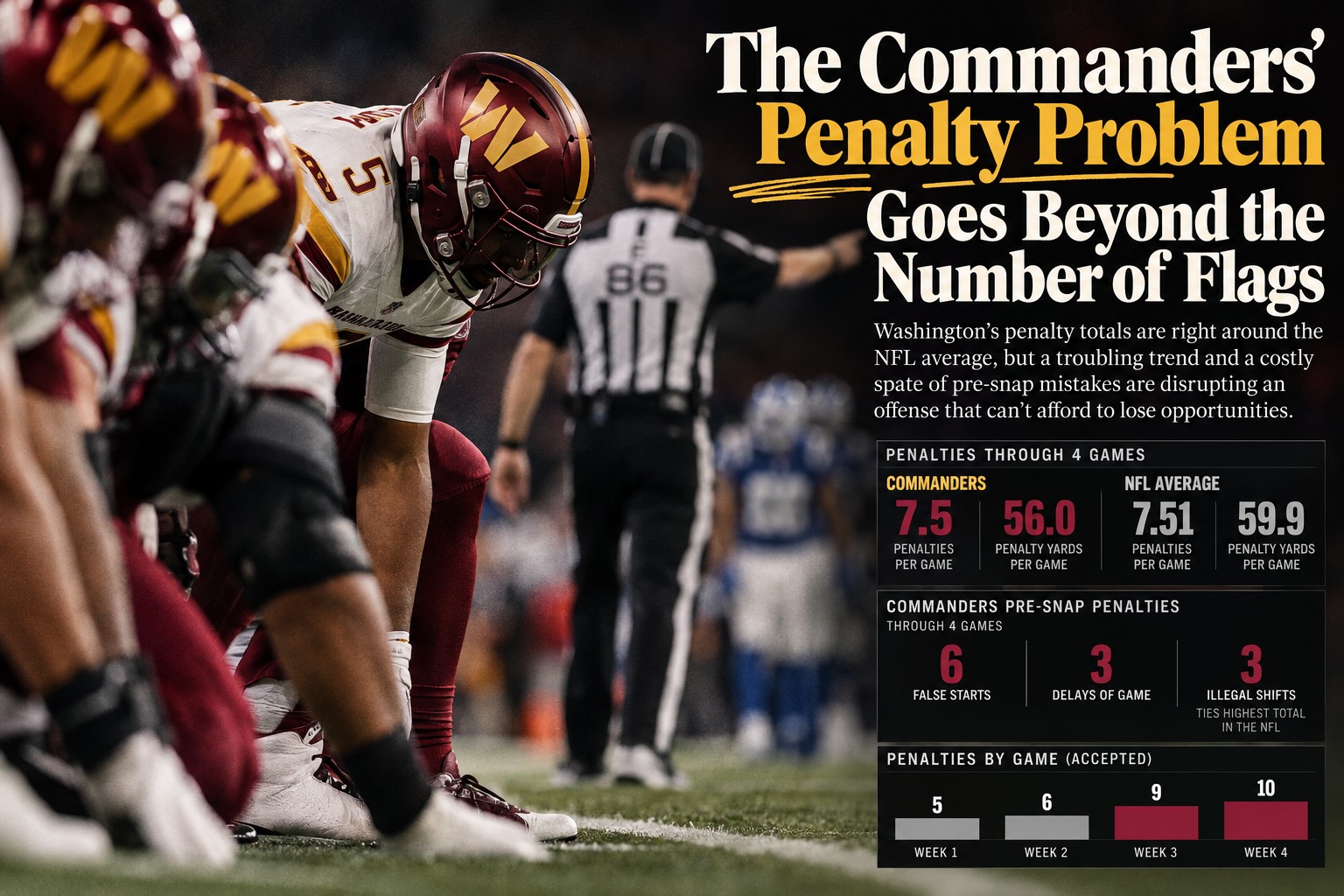
On the surface, the Commanders don't look especially undisciplined compared with the rest of the league. Through four games, Washington has committed 30 accepted penalties for 224 yards, an average of 7.5 penalties and 56 yards per game. The NFL averages are 7.51 penalties and 59.9 penalty yards per game, putting Washington almost exactly at the league average for penalties and slightly below average in penalty yardage. 
But that four-game average hides a troubling trend. Washington committed just 11 accepted penalties over its first two games, an average of 5.5 per game. Against Seattle and Indianapolis, those numbers climbed to nine and 10, respectively, pushing the average over the last two games to 9.5.
Some of the most concerning mistakes are pre-snap penalties. Through four games, Washington has been called for six false starts, three delays of game and three illegal shifts. The false-start total isn't particularly unusual around the NFL, but Washington's three illegal shifts tie the highest total in the league.
Sunday's game against Indianapolis provided the clearest example of why those mistakes matter. Trailing 20–13 in the third quarter, Washington appeared to tie the game when rookie quarterback Athan Kaliakmanis connected with Antonio Williams on a short pass that turned into an 87-yard touchdown. Instead, an illegal shift wiped out the score, leaving the Commanders facing third-and-long deep in their own territory.
Washington failed to convert and Indianapolis followed with a touchdown drive that extended its lead. The Commanders eventually lost 30–13, and while that penalty wasn't responsible for the entire outcome, it eliminated an opportunity to tie the score at a point when Washington was still very much in the game.
There are circumstances worth considering when looking at the increase in penalties. Washington has already used multiple quarterbacks because of injuries to Jayden Daniels and Marcus Mariota, while changes along the offensive line have added another layer of instability. David Blough is also in his first season as offensive coordinator, introducing changes to how Washington operates its offense.
Those changes can complicate communication and timing, particularly before the snap. They may help explain some of the recent mistakes, although the increase in team-wide penalties doesn't necessarily mean the offense is responsible for every additional flag.
Still, the trend is moving in the wrong direction. Washington started the season relatively clean by NFL standards, but its penalty totals have climbed in consecutive games, and the offense has lost valuable opportunities along the way. Whether the problem is related to personnel changes, communication or execution, it needs to be corrected.
The Commanders' overall penalty numbers aren't especially alarming compared with the rest of the NFL. What should concern Quinn is that his team is becoming more mistake-prone as the season progresses, and those mistakes are beginning to have a greater impact on games.