DMV Frontpage Original · Sports
Can Washington Recreate RFK Without Recreating The RFK Gameday?
The new stadium is designed to recapture RFK’s atmosphere, but a transit-heavy stadium district with far less parking could fundamentally change what a Washington football Sunday looks like before kickoff.
# Can Washington Recreate RFK Without Recreating the RFK Game Day?
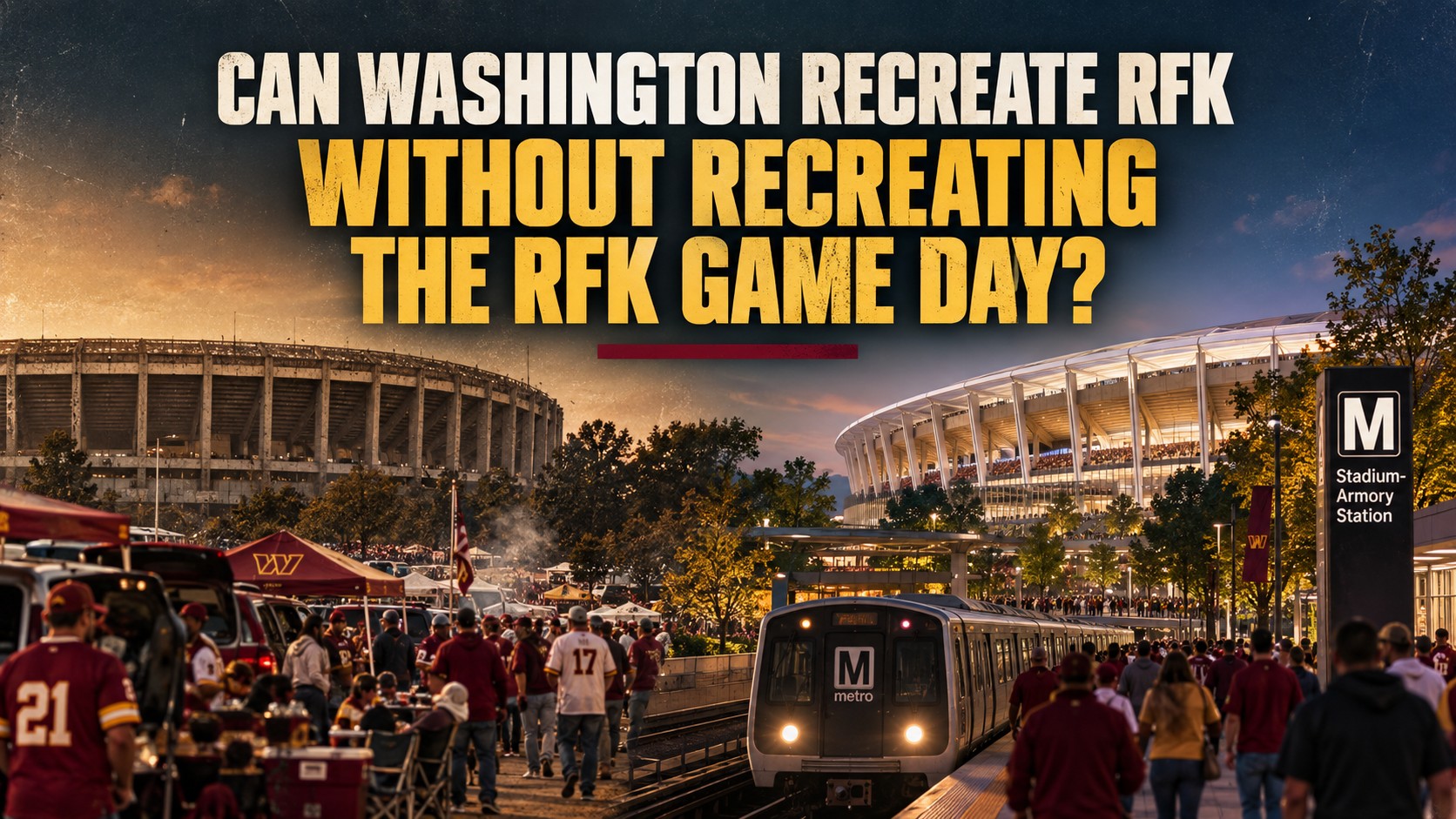
The Washington Commanders have been clear about what they want their new stadium to feel like. When the team unveiled the first renderings of the seating bowl last month, the old RFK Stadium was the reference point.
The continuous bowl, steep seating angles and roof are being designed to create the kind of loud, intimate environment that became synonymous with Washington football during its championship years. Team president Mark Clouse described the goal as honoring RFK's legacy while recreating its energy and intensity.
Recreating RFK inside the stadium, however, is only part of the equation. Outside of it, Washington is planning a game day that could look considerably different from the one many fans associate with RFK, or even the one they experience now in Landover.
The new stadium will sit at the center of a 180-acre mixed-use development built around housing, parks, businesses and public space rather than an enormous collection of parking lots. Current plans call for roughly 6,000 parking spaces, while Metro estimates that as many as 38,000 fans could use rail or bus to attend an event at the 65,000-seat stadium.
That raises a more interesting question than whether there will be enough parking. Washington is trying to recreate the atmosphere and culture associated with RFK while building a surrounding environment that asks fans to experience game day differently.
The District is betting heavily on public transportation to make that possible. On Tuesday, the D.C. Council approved $300 million for improvements to the Stadium-Armory Metro station and another $5 million for the first phase of planning and design for the proposed Gold Line bus system connecting the stadium district with Union Station. Metro has said the existing station isn't capable of handling the projected crowds, with estimates suggesting it could take more than two hours to clear fans after a major event without substantial improvements.
That investment fits the larger vision for the RFK site. Mayor Muriel Bowser has explicitly rejected the idea of building another stadium surrounded by parking lots, while the city's master plan calls for thousands of homes, parks, recreation areas, businesses and improved access to the Anacostia River. The stadium is supposed to anchor a neighborhood that works throughout the year rather than occupy land used primarily on football Sundays.
The challenge is that Washington football has always had a significant culture outside the stadium, and much of it has developed around tailgating. That culture survived the move from RFK to Landover and endured through some of the franchise's worst years. The Washington Post noted in 2023 that the parking lot was often the best part of attending games during the Daniel Snyder era, with large organized tailgates, smokers, tents, converted buses and groups of fans who had built their own Sunday traditions.
Those traditions didn't begin in Landover. A Washington Post account from the final Redskins game at RFK in 1996 described fans holding one last tailgate in the stadium lots, including a season-ticket holder tending the Weber grill he had set up in the same corner for 20 years. Tailgating was unquestionably part of the RFK experience, which means Washington has to account for it if the goal is to reconnect the franchise with that history.
But preserving RFK's culture isn't necessarily the same thing as preserving acres of parking.
Another Post story from 1984 described the surrounding neighborhood filling with vendors, fans looking for parking and crowds streaming toward RFK from the Metro station. Metro had already become part of attending games by then, and the stadium existed within the city in a way Northwest Stadium never has. Cars and tailgates were part of the experience, but they weren't the entire experience.
The new plan takes that model considerably further. The Commanders aren't ignoring tailgating, either. In planning documents submitted earlier this year, the team called it a decades-long part of the game-day experience and said it intends to accommodate tailgating on surface lots and a festival plaza when the stadium opens.
The complication comes later. As development gradually replaces those surface lots, the plan anticipates some tailgating moving to the upper levels of parking garages. The final master plan also identifies open space near the stadium as another possible location for it.
Those solutions could work. A tailgate on the roof of a parking garage can still have grills, music, food and thousands of Washington fans, while a plaza could develop traditions of its own. Fans arriving by Metro could join those spaces without needing a parking pass, potentially making some parts of the pregame experience more accessible rather than less.
What planners can't know is whether those spaces will produce the same kind of culture. Some of the best game-day traditions exist because people have occupied the same parking spaces with the same friends for years, arriving hours before kickoff and creating something that wasn't programmed by the team. Providing designated places to tailgate preserves the activity, but the experience that eventually develops in those places will be up to the people using them.
That is where Washington's effort to recreate RFK gets complicated. The organization is borrowing heavily from the old stadium as it designs the building itself, from the shape of the seating bowl to the emphasis on crowd noise. At the same time, the District is intentionally designing the surrounding development around fewer cars, much greater reliance on transit and land that remains useful when there isn't a football game being played.
The two ideas aren't necessarily incompatible, and the history of RFK suggests they may fit together better than they initially appear to. The old stadium was both a tailgating destination and an urban stadium served by Metro, surrounded by neighborhoods that became part of the experience on game days. Washington doesn't have to choose between restoring every parking lot that once surrounded RFK and abandoning the traditions that existed there.
It does have to figure out how those traditions translate to a different environment. The District can expand Metro, the Commanders can reserve space for grills and tents and architects can design a stadium intended to sound like RFK, but none of them can dictate what fans will actually do with those spaces over time.
That's ultimately the difference between recreating a stadium and recreating a game day. Washington can borrow the architecture and some of the traditions of RFK, but the original became special because of what developed around it over decades. If the new stadium succeeds in doing the same thing, it probably won't be because every part of the old experience was reproduced. It will be because the new place gives Washington fans enough room to build one of their own.