DMV Frontpage Original · Sports
Washington Is Stopping the Run, but Its Pass Defense Remains a Major Problem
Washington has made major strides against the run, but three games into the season, opposing quarterbacks continue to expose a struggling secondary.
# Washington Is Stopping the Run, but Its Pass Defense Remains a Major Problem
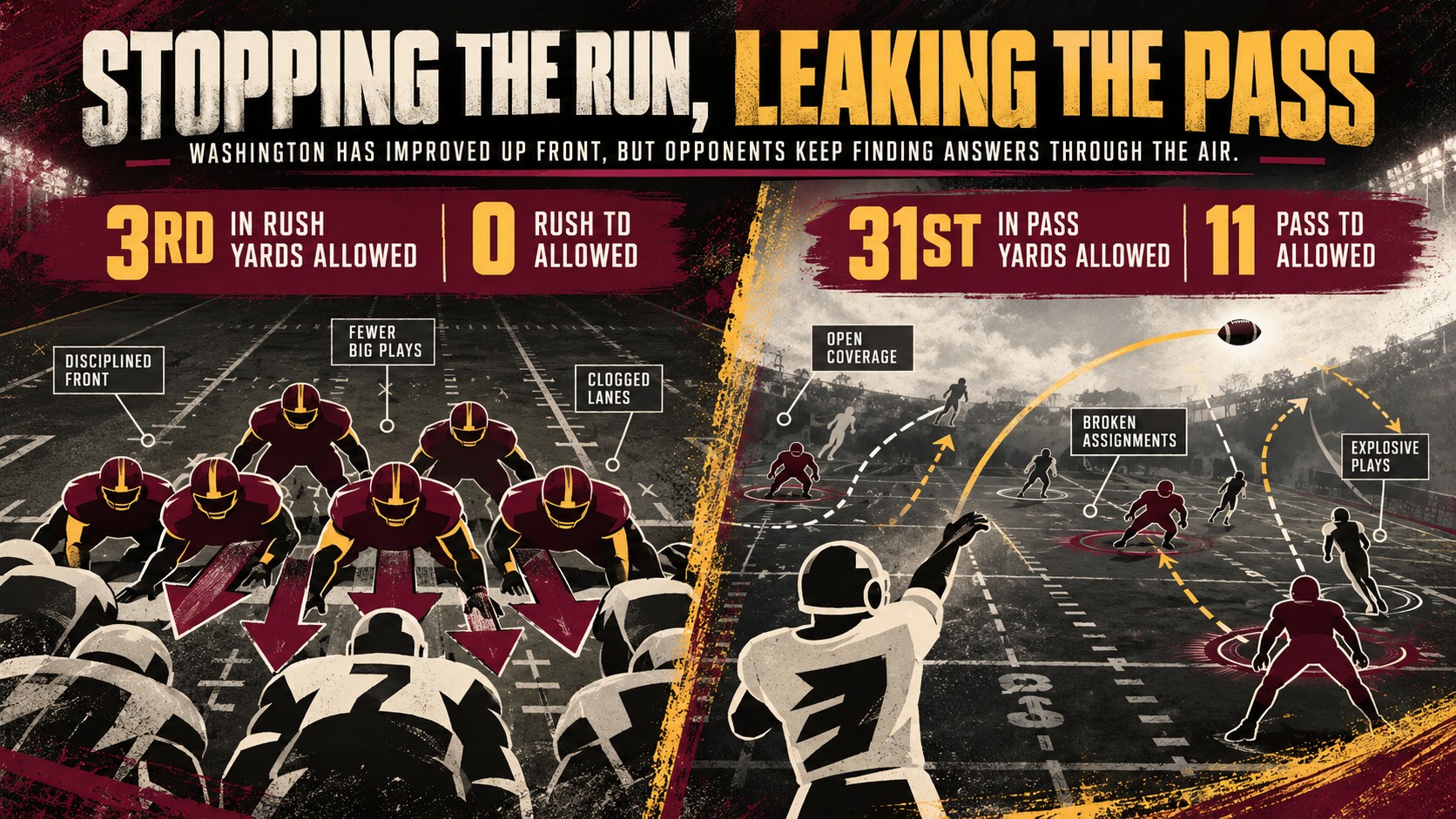
There are plenty of reasons to be encouraged by what the Commanders defense has accomplished against the run through their first three games. Washington ranks third in the NFL in rushing yards allowed and has yet to surrender a touchdown on the ground. That's a dramatic improvement for a defense that finished 30th against the run in 2025 but it hasn't translated into the kind of overall defensive performance Washington had hoped for.
While the Commanders have become considerably more difficult to run against, opposing quarterbacks have had little trouble moving the football through the air. Washington ranks 31st in passing yards allowed and has surrendered an NFL-high 11 touchdown passes through its first three games. The Eagles threw for three touchdowns in Week 1, the Cowboys added four in Week 2 and Seattle scored all four of its offensive touchdowns through the air on Sunday.
That raises an important question about just how much Washington has improved defensively. Stopping the run is an important part of any defense, but it becomes considerably less valuable if opposing offenses can consistently find success throwing the football. The Commanders have made progress in one area while continuing to struggle in another, and the disparity between the two has become difficult to ignore.
Washington allowed nearly 142 rushing yards per game last season and surrendered an average of 4.8 yards per carry. This year those numbers have fallen to 82 yards per game and 3.8 yards per carry. The Commanders also lead the NFL with a 25 percent stuff rate, despite rarely loading the box with additional defenders.
The defensive line deserves considerable credit for that improvement. Daron Payne, Javon Kinlaw and Tim Settle have helped Washington become more physical up front, while rookie linebacker Sonny Styles has already demonstrated why the Commanders invested the seventh overall pick in him. There are legitimate reasons to be encouraged by what defensive coordinator Daronte Jones has accomplished against the run, although three games are hardly enough to declare the problem permanently solved.
Seattle provided a particularly interesting example of both Washington's progress and its limitations. The Seahawks entered Sunday's game ranked ninth in rushing offense, but managed just 44 yards on 18 carries against the Commanders. They even threw three consecutive passes from Washington's two-yard line during the second quarter, eventually turning the ball over on downs. It was the kind of defensive performance against the run that Washington struggled to produce throughout much of last season.
Unfortunately, Seattle had considerably more success throwing the football. Sam Darnold finished with 379 passing yards, while the Seahawks accumulated 437 yards of total offense. Washington's three takeaways helped secure a badly needed victory, but Seattle still scored 31 points and came within two points of winning despite getting almost nothing from its running game.
Washington's problems in pass coverage were already a major concern before Seattle arrived. After struggling against Philadelphia and Dallas, the Commanders spent considerable time discussing communication problems and the explosive passing plays that had hurt them during their first two games. The coaching staff also began making changes to the secondary, most notably involving Mike Sainristil.
The third-year cornerback entered the season as one of Washington's starting outside corners, but after two difficult performances, the coaching staff moved him back to nickel against Seattle. Veterans Rasul Douglas and Fabian Moreau took over the outside responsibilities alongside Amik Robertson, while Sainristil played only 39 percent of the defensive snaps.
The adjustment hasn't solved Sainristil's problems. According to NFL Pro statistics reported by The Washington Post, he was targeted four times against Seattle and allowed four completions for 41 yards and two touchdowns. He's now surrendered five touchdowns through three games, the most of any defensive back in the league. Dan Quinn confirmed Wednesday that Washington intends to continue using Sainristil at nickel while rotating Douglas and Moreau outside.
But the secondary's problems extend well beyond Sainristil. Douglas has also struggled in coverage, and Jones has repeatedly pointed to communication as an area that needs improvement. Before the Seattle game, Jones explained that the coaching staff had simplified some defensive calls to reduce the number of decisions players needed to make before the snap. The idea was to eliminate some of the uncertainty that had contributed to breakdowns during the first two weeks.
Simplifying the defense may help players get into the correct positions, but it doesn't necessarily solve every problem once the ball is snapped. Moving Sainristil inside might allow him to play a position better suited to his abilities, but Washington still needs its outside corners and safeties to hold up in coverage. The personnel changes also suggest the coaching staff recognizes that communication alone may not explain everything that's gone wrong.
There is another distinction worth considering when evaluating Washington's defensive progress. The Commanders have faced only 64 rushing attempts through three games compared with 102 passing attempts. Some of that reflects the opponents they've played and the situations those teams encountered, but the disparity makes it especially important to look beyond rushing yards allowed per game when evaluating the defense.
Washington's improved yards-per-carry average and ability to stop running plays behind the line of scrimmage provide evidence that the progress is genuine. However, an offense doesn't necessarily have to establish the run to win a football game, particularly when its quarterback can consistently exploit favorable matchups in the secondary. Washington is already discovering how difficult it can be to turn an improved run defense into victories when opposing teams remain productive through the air.
Sunday's game against Indianapolis should provide another opportunity to evaluate that progress. Colts running back Jonathan Taylor enters the matchup among the NFL's leading rushers and presents a significant challenge for Washington's defensive front. If the Commanders can contain him, it would provide additional evidence that their improvement against the run can hold up against talented opponents. But they'll also need to demonstrate that stopping the run doesn't leave them vulnerable elsewhere.
Washington doesn't need to abandon what's working against the run. It needs to find a way to make that improvement matter more by preventing opponents from having so much success throwing the football. Until that happens, the Commanders could continue producing impressive rushing statistics without seeing the improvement in their overall defense that those numbers would seem to suggest.